Muelle de Castilla
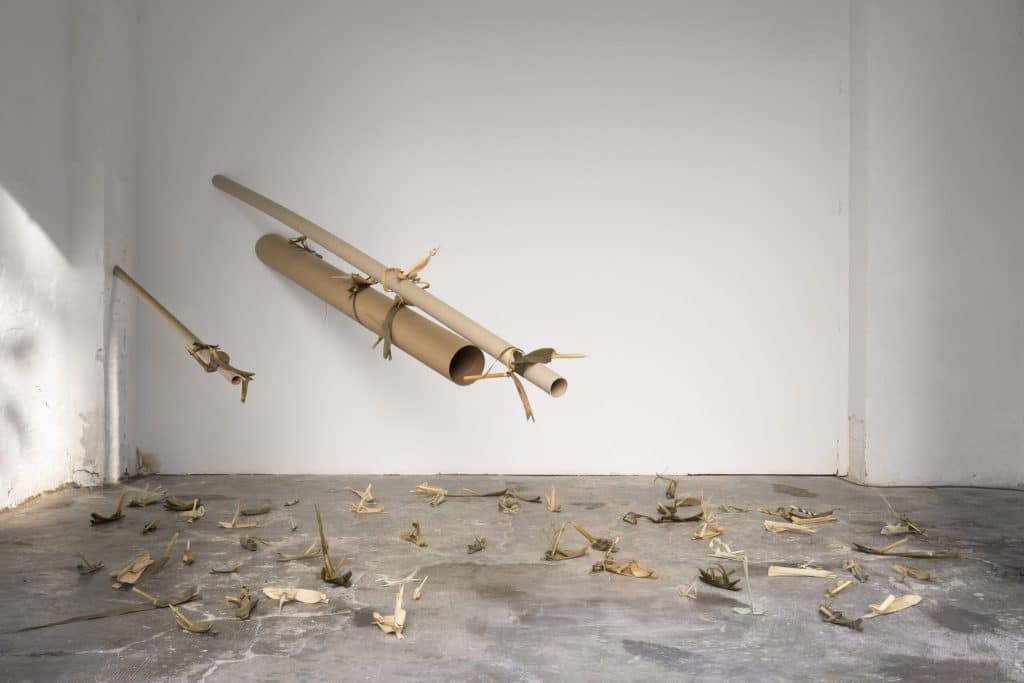
The exhibition, curated by Freya Day in collaboration with Cultura Verda, takes its name from one of the infrastructures of the Port of Tarragona and translates into sculpture some of the forms that make the circulation of materials possible. Reliefs and tubular structures spread across the wall and floor with inclinations reminiscent of loading ramps, tanks, or pipelines, while their surfaces incorporate textures linked to the materials that have passed through the port and to the sediments that shape the coastline. The result does not seek to reproduce these infrastructures, but rather to work from the same physical logics that construct them.
But the traces of these movements are not only physical: they are also inscribed in the names of places. Toponymy preserves trajectories and former geographies that the territory’s transformations have gradually covered over, and Llavaneras finds in this a kind of record that keeps functioning even once the landscape has already changed. Words thus behave like linguistic fossils, remnants capable of fixing in the present something of an earlier territory.
The papers documenting the port’s activity also end up transformed into sculptural matter. Llavaneras works with records of origins and quantities, folding or compressing them into tube and funnel shapes. The information loses its original layout on the page and comes to occupy space, as if the data followed the same process of transformation as the goods it documents.
Some pieces also incorporate organic materials that will continue to change over the course of the exhibition. Crystallization and degradation will progressively alter the surfaces, so that time too intervenes on sculptures built precisely from processes of sedimentation and transformation.