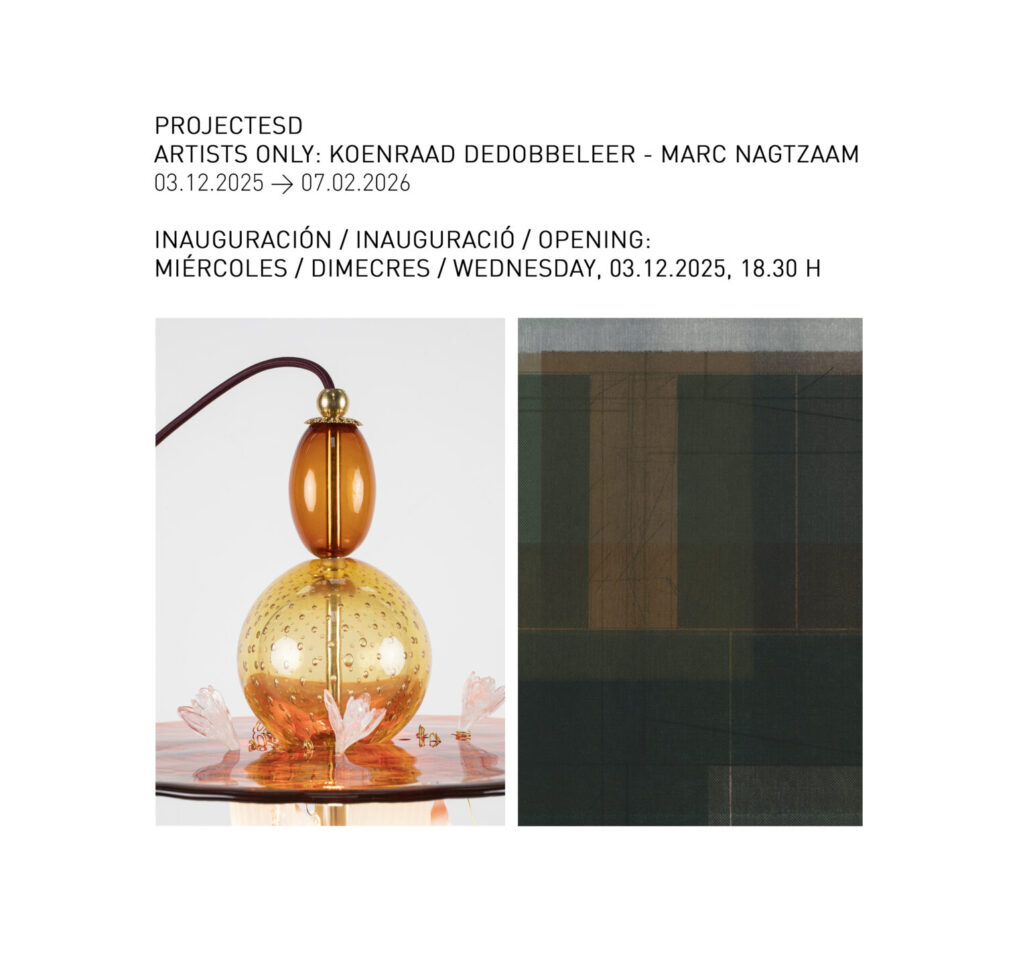
Koenraad Dedobbeleer & Marc Nagtzaam. ARTISTS ONLY
Artists only is a duo show featuring works by Dutch artist Marc Nagtzaam and Belgian Koenraad Dedobbeleer. The exhibition is a get together, a sort of exercise of improvisation, far from fitting in any preestablished defined concept. The exhibition’s title comes from a Talking Heads song of 1978. In a recent presentation-performance that Dedobbeleer gave in Paris he played a few songs, Artists only among them. An excellent pick that seems appropriate to give title to a show where “only” the artists work is at play.
Marc Nagtzaam works in drawing. For him, to draw is to construct an unknown place for the artist and the public to live in: “The drawings”, he says, “are like empty spaces, parallel to the world. I try to create a place that is not clearly defined.” Done in grey graphite, his drawings have their sources in architectural details, the vocabulary of graphic design, photographs or magazines. These different sources are reduced to their most elementary expression. Dots, lines, strokes, stripes, bands or words, create a space on the surface of the paper. In a way, Nagtzaam’s approach to his work evokes the process of the collage.
Collage, not in a literal sense, can be said to be at the core of Koenraad Dedobbeleer’s practise. He is an artist who explores objects, who assembles forms, material and knowledge coming from different sources into new hybrid sculptural objects. He is known for his sculptures and installations in which everyday objects (such as a lamp, a key holder, a door knob, or a plant pot) are modified, assembled, and recontextualized with a distinctive tongue-in-cheek – and at times even burlesque, ironic – spirit. Nourished by an in-depth knowledge of art history and inexhaustible technical resources, the artist’s work establishes an ongoing dialogue with a broader tradition of sculpture, including its relation to architecture, industrial design, DIY culture, images, and book making.
From one work to the next, across this bold and somehow eccentric juxtaposition of Dedobbeleer’s and Nagtzaam’s dissimilar universes, a special context is created in which both artists let the works have a conversation with no definite purpose. There may be a connection, an inner logic running from one work to the other, through multiple links and crossed relationships, but one that is not intended to be conclusive. The final interpretation is left to us.