La montaña sagrada. Suwon Lee
In La montaña sagrada (The Sacred Mountain), Suwon Lee brings together three lines of work which, though distinct in form and materiality, converge within a single constellation of meaning. The mountain appears as a metaphor for origin, the body, and memory, and as a site from which to reflect on the diasporic experience.
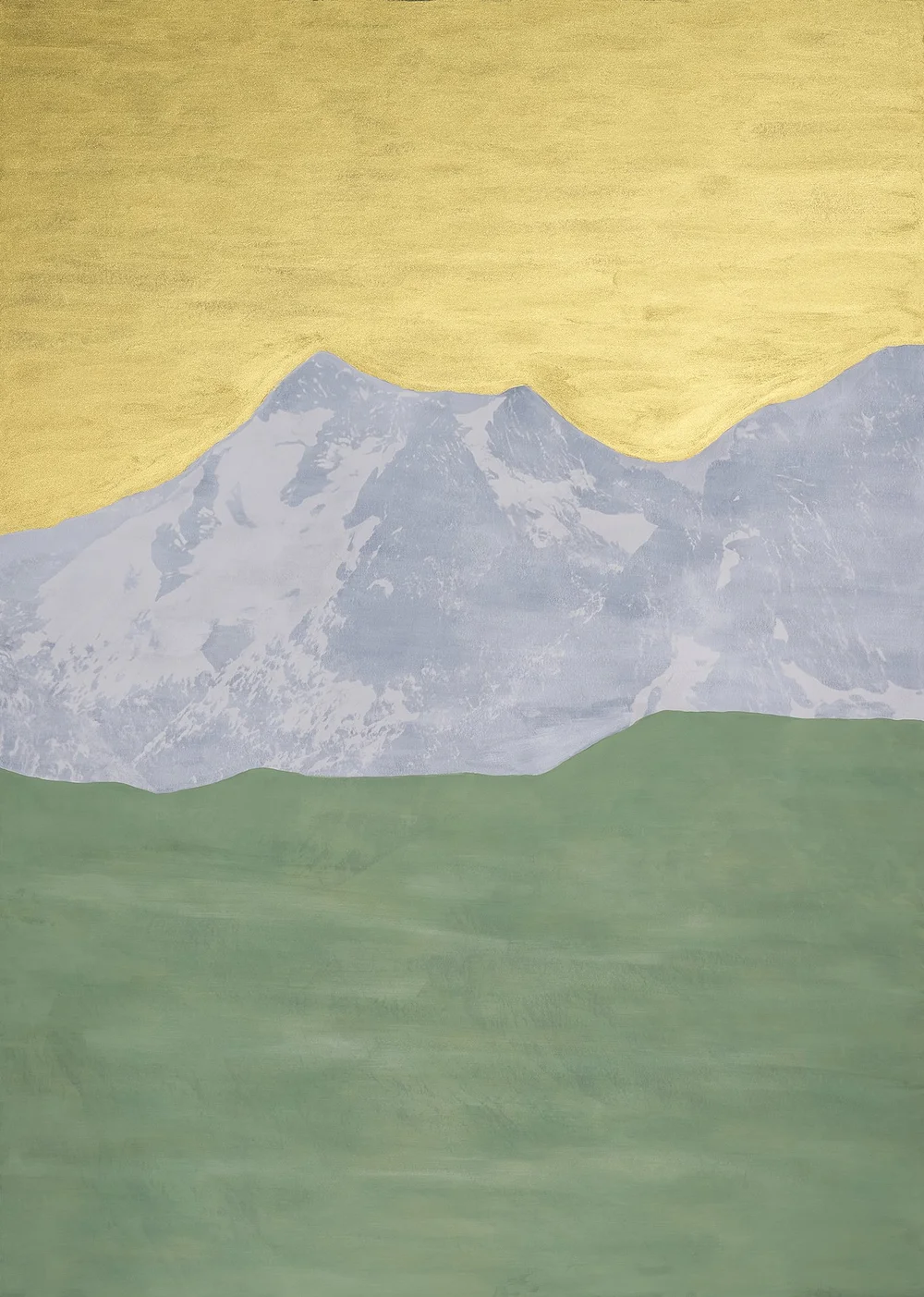
The main series, titled La montaña sagrada, focuses on mountains from different geographies, among them Pico Bolívar, the Sierra Nevada de Santa Marta, Mount Shasta, Mont Blanc, Mount Everest, and Mount Teide. Working from images taken from vintage postcards that the artist collects, enlarges, prints, and intervenes with oil pigments, these works activate the landscape as a territory with a spiritual dimension. The interventions do not seek to idealize the sites, but rather to awaken their symbolic power; they project experiences of displacement, loss, and the search for belonging.
Within this series, the Canaima diptych occupies a central position. In this work, the tepuis, sky, and earth are articulated together with water, present both as river and waterfall, forming an image in which these elements converge. More than a representation of a specific landscape, Canaima functions as a symbolic synthesis in which geological, atmospheric, and fluvial forces intertwine in a tense, dynamic balance. The work condenses an understanding of territory as an energetic field and a space of origin, a place where material and spiritual dimensions overlap. In this sense, Canaima emerges as an affective and conceptual core of the project, an image of high symbolic intensity from which the rest of the series is structured.
Lee conceives the mountain as a place one enters, one that demands time, presence, and attention, rather than as a space defined by the conquest of a summit. In this way, artistic practice becomes contemplative, and looking turns into a form of dwelling.
This notion extends into the series Dictée/Exilée, composed of collages and a video derived from the performance of the same name presented at Americas Society in 2024. In these works, language unfolds like a linguistic mountain, stratified by layers of memory, migration, and silence. Drawing on texts from the work of Theresa Hak Kyung Cha, Lee overlays images of prisons in which political prisoners in Venezuela are held onto landscapes, configuring a topography of political trauma and diasporic memory that alludes to notions such as border, absence, and blurring.
Alongside these works is Tejiendo de origen (Weaving Origin), composed of two vintage photographs of the artist’s grandparents that are interwoven and suspended in space, functioning as a genealogical foundation. Here, the gesture of joining the images operates as an act of repair, in which genealogy and affection intertwine as an emotional root and a point of return.
Taken together, the works construct a sensitive cartography in which genealogy, language, and memory intersect with the experience of territory. The mountain is not a fixed symbol, but a method and a practice of attention, a way of seeing, remembering, and remaining.