La montaña sagrada. Suwon Lee
In La montaña sagrada (The Sacred Mountain), Suwon Lee brings together three lines of work which, though distinct in form and materiality, converge within a single constellation of meaning. The mountain appears as a metaphor for origin, the body, and memory, and as a site from which to reflect on the diasporic experience.
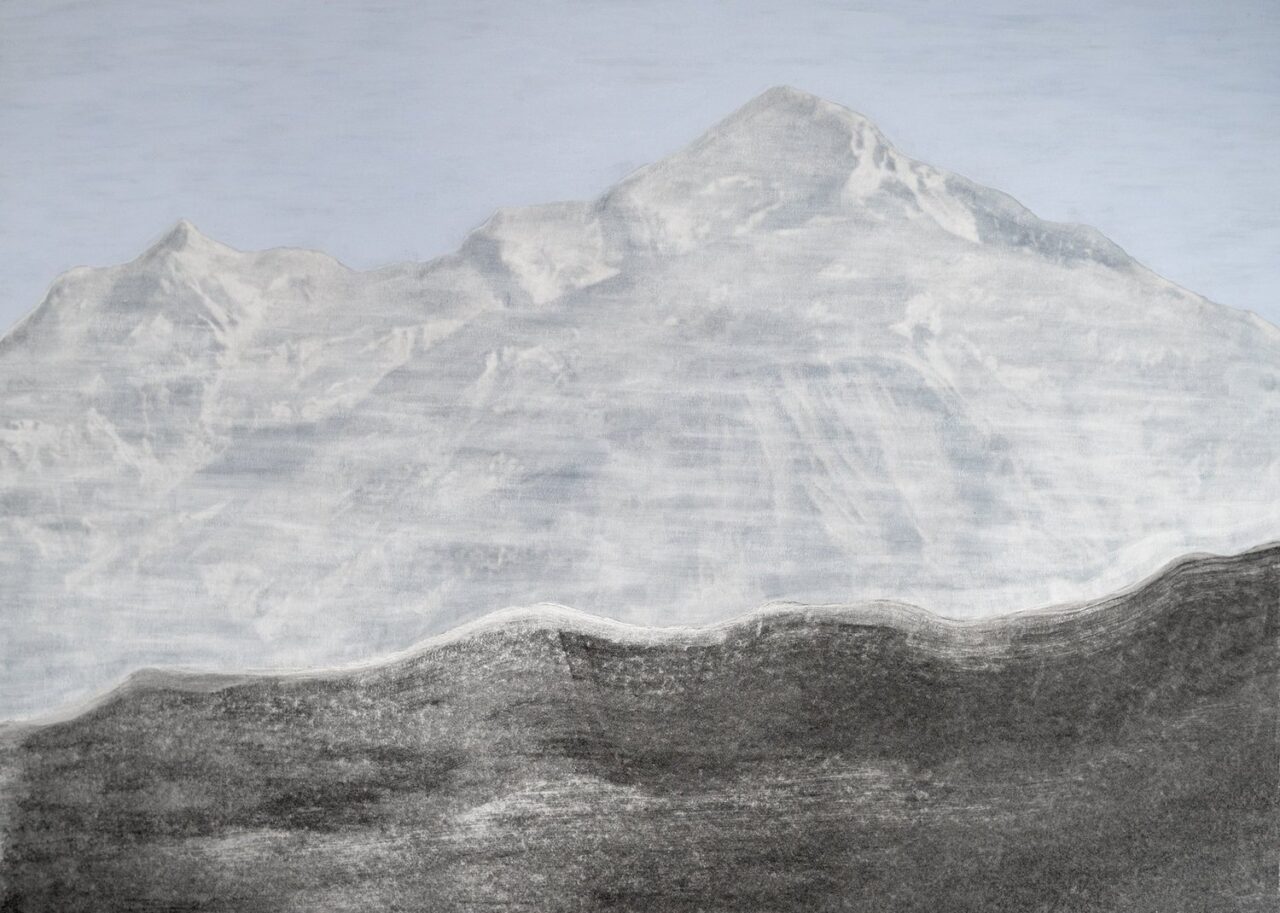
The main series, titled La montaña sagrada, focuses on mountains from different geographies, among them Pico Bolívar, the Sierra Nevada de Santa Marta, Mount Shasta, Mont Blanc, Mount Everest, and Mount Teide. Working from images taken from vintage postcards that the artist collects, enlarges, prints, and intervenes with oil pigments, these works activate the landscape as a territory with a spiritual dimension. The interventions do not seek to idealize the sites, but rather to awaken their symbolic power; they project experiences of displacement, loss, and the search for belonging.
Lee conceives the mountain as a place one enters, one that demands time, presence, and attention, rather than as a space defined by the conquest of a summit. In this way, artistic practice becomes contemplative, and looking turns into a form of dwelling.
Taken together, the works construct a sensitive cartography in which genealogy, language, and memory intersect with the experience of territory. The mountain is not a fixed symbol, but a method and a practice of attention, a way of seeing, remembering, and remaining.