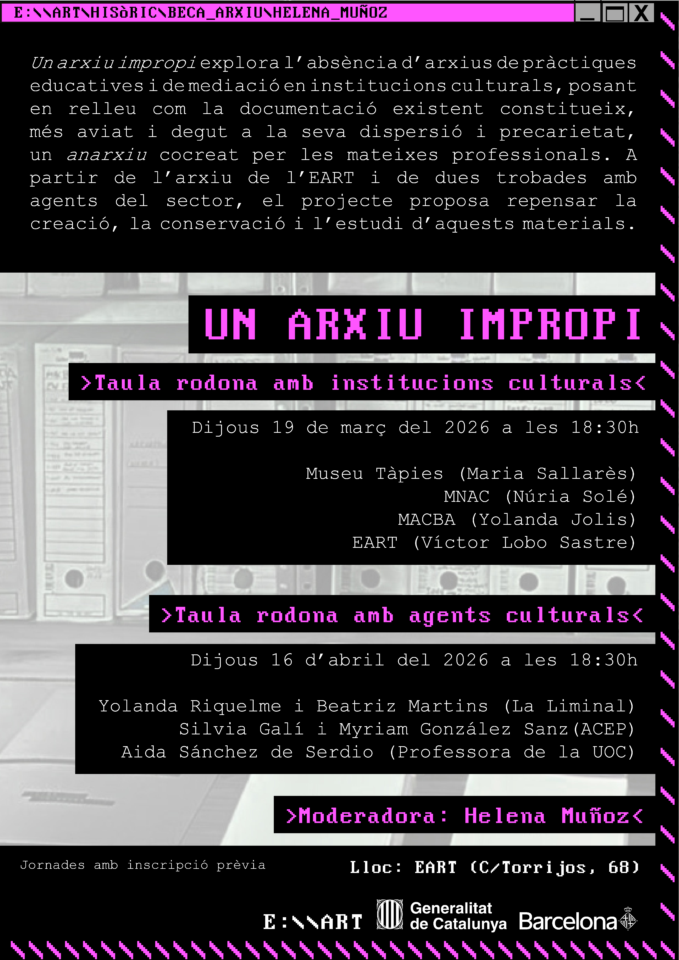
Round Tables - An improper archive by Helena Muñoz
Round Tables
These sessions are designed to reflect on the research carried out during Helena Muñoz’s residency at EART, who will moderate the sessions.
Round table with cultural institutions:
\ 19 March 2026 at 6:30 p.m.
\ A conversation to reflect together on the function and meaning of archives in institutions and their documentation practices.
Participating institutions:
\ Tàpies Museum (Maria Sellarés)
\ MACBA (Yolanda Jolis)
\ MNAC (Nuria Solé)
\ EART (Víctor Lobo Sastre)
–
Round table with cultural agents:
\ 16 April 2026 at 6:30 p.m.
\ A conversation between cultural agents to understand the para-institutional vision of archives and the relationship they establish with documentation through their relational and educational practices.
Participants:
\ Yolanda Riquelme and Beatriz Martins (La Liminal)
\ Silvia Galí and Myriam González Sanz (ACEP – Catalan Association for Heritage Education)
\ Aida Sánchez de Serdio (Researcher and lecturer)
Round Tables with prior registration
*
An improper archive is a research project that aims to review the existence and non-existence of archives linked to educational and mediation practices in cultural institutions, based on the EART’s own archive, which is an exception in the preservation of documentation linked to this type of project thanks to the nature of its activity focused on education and its more than 30 years of history. The research focuses on the lack of structures that preserve and make accessible all these materials, which bear witness to what is happening in this field. Likewise, based on a critical reflection on the notion of archives, it addresses the prototyping of possible resources for the documentation of processes and the creation and care of archives within the framework of cultural institutions, focusing specifically on museums.
While museography departments have consolidated archives, documentation centres and libraries specialising in art, education and mediation departments often depend on the efforts of female workers to document, preserve and archive their practices. Thus, what we find today is more of an anarchive, that is, a scattered, fragmented, and disordered archive, the result of the will and need of the professionals themselves to document and preserve those traces that can highlight both their own work and what happens in the processes that take place.
The dispersion, precariousness, indeterminacy, destructuring and even non-existence of documentation highlights, on the one hand, the situation of education and cultural mediation within cultural institutions which, although today they depend on and are defined by their social function, continue to maintain a subordinate and accessory character with respect to other areas. On the other hand, it reveals the impossibility of conducting research in this field, promoting the transfer of knowledge and applying new critical perspectives that would allow us to know what to replicate or improve in what we do, but also what we still need to do, among other things.
In its implementation, the project aims to contribute to the creation of tools and resources for rethinking and creating documentation processes and spaces for the conservation and study of educational and mediation practices. To this end, the research opens up two spaces for reflection, inviting voices from the sector to participate. Firstly, different representatives from museum institutions in Barcelona are invited to situate, from different fields of work, the scenario in which we find ourselves and where we want to go with regard to the issues raised. Secondly, we are inviting sector associations and independent professionals who, from a liminal space between the inside and outside of the institution, can tell us about their own experience in the field of education and mediation in terms of documentation and archiving processes.
The 2025/2026 Archive Grant is mentored and supported by Antonia del Rio.