Vacilaciones. Estados de Visibilidad, Iván Candeo
«There is a destination, but no path; what we call a path is nothing more than our hesitation.»
Franz Kafka
Of the five versions of Black Square on White Ground that Kazimir Malevich produced, perhaps the most celebrated is not any of those displayed in Russian museums, nor the one considered lost, but rather the version that appears in a photographic document of the exhibition 0,10. The Last Futurist Exhibition, held in 1915 in what was then Petrograd.
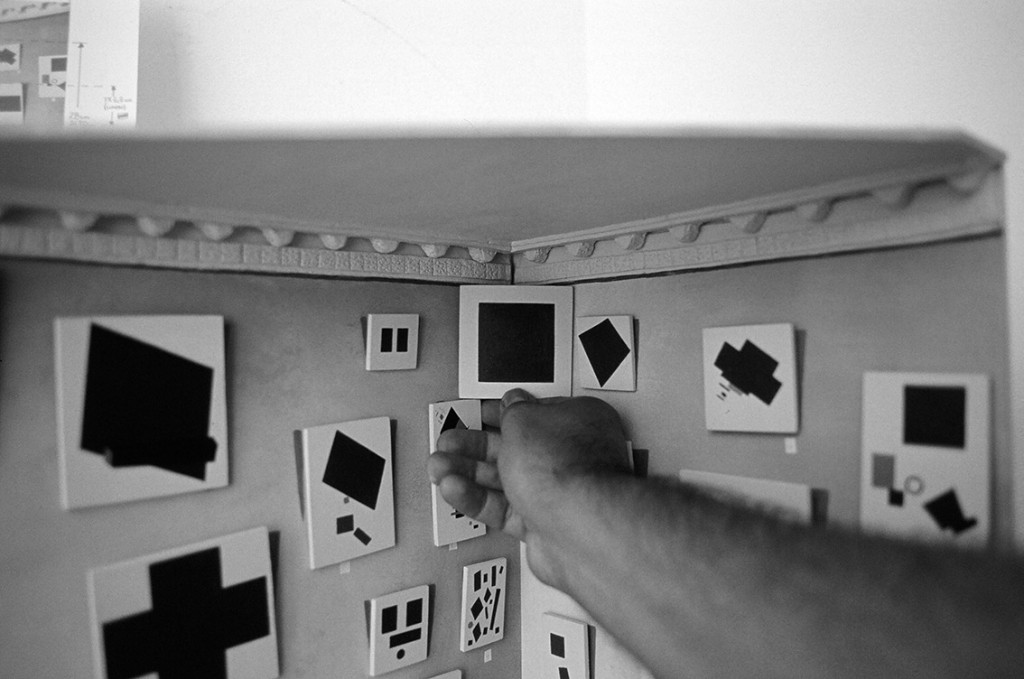
Paradoxically, another artist bearing a Soviet name, the Venezuelan Iván Candeo, returns to this anonymous image just days after the 110th anniversary of the closing of that famous exhibition, and focuses on something that had already astonished audiences at the time: they were not only perplexed by the works on display, but scandalized by the fact that Malevich had deliberately hung the canvas of greatest hermeticism in the «corner of honor» of the gallery, the place where Russian Orthodox tradition dictates that icons should be placed.
Candeo transforms the photograph into a three-dimensional maquette and, in doing so, seems to follow the designs of Malevich himself, who abandoned painting a few years later to focus on architectural theory.
Any maquette is a representational device that allows projects not yet realized to be visualized; however, Candeo uses this medium in the opposite sense: through it, he reconstructs an event that has already taken place, even «translating» into another code what the photograph recorded in 1915. Hence the fact that both the maquette and the image share an identical black and white.
Black Square on White Ground is considered «the zero point of painting», while the exhibition 0,10 itself alluded to a moment of destruction of the old world, to zero or to the tabula rasa that marks every new chronology.
In addition, the artist has photographed the maquette from different angles and types of shot, scanning the negatives and preserving the small frames of the analog film. The images have been printed at a size that maintains a 1:1 scale of the black square in relation to the maquette. In some of them, his hand can be seen holding the small piece and placing it in its corresponding position, as a gesture of Brechtian estrangement or of prospective anachronism.
Alongside the installation Transparent Malevich (2025), a series of drawings is exhibited, Untitled (Angelus Novus) (2022–25), made with closed eyes, from memory, so to speak. The motif that «appears» is the well-known 1920 work in which Paul Klee refers to a legend originating in the Talmud. Walter Benjamin used it for his theory of the «Angel of History». Ariella Azoulay, Michal Heiman, Boris Groys, and Giorgio Agamben, among others, have added new and suggestive interpretations.
Candeo incorporates three elements that should by no means be considered minor. The first relates to the recreation of the blind angel-watchman, as if in this way he were denying the hierarchical character of the visual, as if that eye which provides visions, which glimpses events, could also «be seen» by touch. On the other hand, the notion of seriality and automatism takes on an exorcising aspect here. The artist constructs a kind of infinite score that disauthorizes all those stellar moments that history considers—and collects—perhaps pointing instead to blind points, to delays of time that return again and again until they become epiphanies. Finally, the transformations of Klee’s drawing into graffiti endow the angel who contemplates the past and the future with a disruptive power: they profane its sacramental character, bring it from the beyond of the sacred into the here-and-now of the human, restore its role among the things or burdens of this world.
Valentín Roma