El Pirineu: paisatge enllà, pintura endins. Muma
When we were little, our whole family would go to the Pyrenees for a good week, around Saint John’s Day, to the Vall de Boí: a tent, sleeping bags, and endless hikes. Those were the years 1966–69; there was hardly anyone there, and you still reached Taüll by a cart track. Later, between the ages of 18 and 20, I did a lot of ski touring and, with the CEC, took part as a volunteer in organizing the Ralli CAI CAF (1976), outfitting the Renclusa hut and carrying out other tasks.
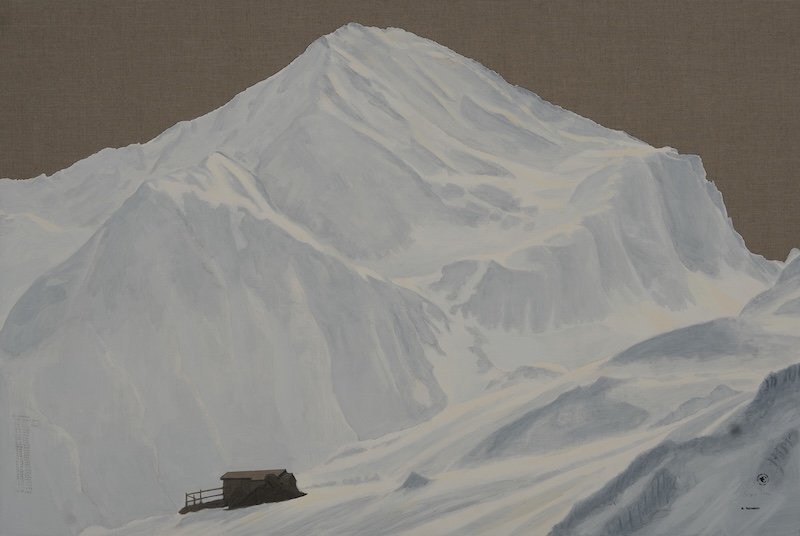
Now, as a visual artist, I have been working on mountain territory for more than 12 years—first in the Alps and then in the Pyrenees. I don’t paint the high mountains, but rather the inhabited mountain landscape, colonized by humans. What has interested me about the Pyrenees are the pastures and pastoralism, the passes, the routes used by refugees and by smugglers; also the mines and the forges (18th and 19th centuries), alpinism and mountain huts, and, finally, leisure and all snow sports. For the past four years, I have made one trip every year to the Pyrenees—10 days each time—to draw and scout locations. And I’ve done a great deal of reading, too. Obviously, the peaks provide an invaluable backdrop.
I’ve been accompanied by Verdaguer, with his journey on foot from Canigó to the Maladeta massif, and by Ramond de Carbonnières, with his foundational book on the Pyrenees from almost 240 years ago. And many others.
For me, painting makes it possible to convey a holistic view of this territory with all the elements of life: economy (agriculture, livestock farming, iron, charcoal, timber, trade, tourism, spa towns), social organization (the commons, transhumance, mills, sawmills, transport, the timber rafters), culture (language, place names, music, literature), traditions (falles, markets, dances, rituals), leisure (mountaineering, skiing), movement and circulation (paths, passes, border routes), energy (water as mechanical power, electricity), and architecture as a witness to time (styles, types of construction, urban furniture).
To paint the Pyrenees (and the snow that is disappearing) is to confront complexity, to confront the fragility that comes before change, and at the same time to equip oneself with tools to reinvent the territory and to imagine the future.