Opening of Gran ritmo by Paula García-Masedo. Part of the Legacies in Potential cycle.
With the collaboration of the spinning community of Villarejo de Salvanés
With the contribution of Julia Ramírez-Blanco
Curated by Oriol Fontdevila
From 24 July 2026 to 7 February 2027
Opening: Friday, 24 July at 7 pm
Canònica de Santa Maria de Vilabertran
A co-production by the Agència Catalana del Patrimoni and Bòlit, Centre d’Art Contemporani de Girona.
Supported by a 2025 Leonardo Grant for Scientific Research and Cultural Creation from the BBVA Foundation
Legacies in Potential is an exhibition cycle organised by Bòlit, Centre d’Art Contemporani de Girona, presenting newly created artistic projects based on a series of case studies concerning heritage controversies that either originate in or have ramifications across the Girona region.
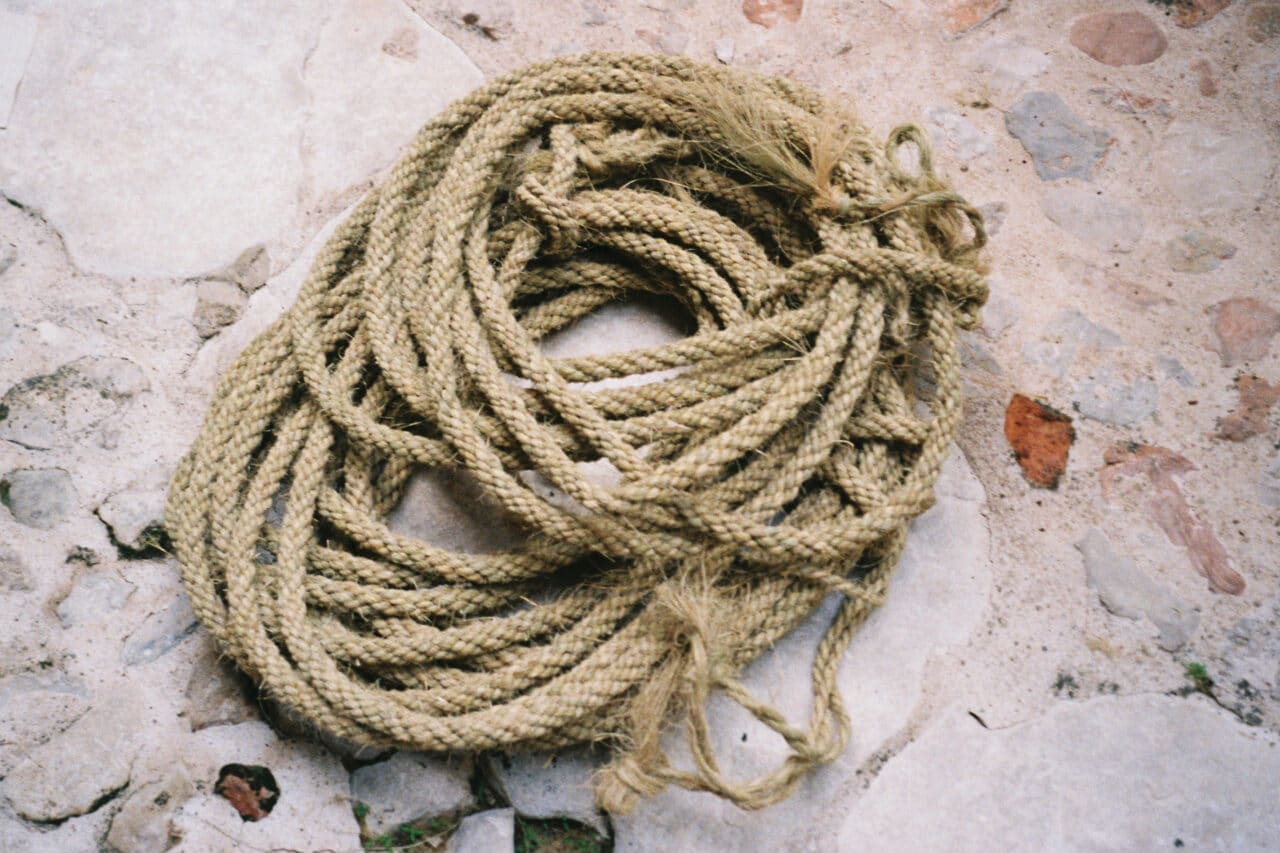
For many years, rope-making has shaped the braiding of ways of life, and even of worldviews. Manually twisting organic esparto fibres into ropes has been a way of intimately interweaving social projects with belief systems, as well as substantialist economies with the semi-arid climate of the Iberian steppes and the Mediterranean.
Paula García-Masedo (Madrid, 1984) refers to the circularity that emerges between the movement of the arm twisting the rope, the movement of matter within the territory, and seasonal cycles as a carefully synchronised choreography, a great rhythm. Although it has taken many years to understand that, in the formation of systems, no single thread entirely determines either the fabric or the skein, while at the same time none is ever completely subordinated to them.
Humanism placed the puppeteer (the human) at the centre and attributed to it the full capacity for agency. Anti-humanism, by contrast, emphasised the effect that the puppet (matter) exerts upon the puppeteer in determining a range of possibilities. Historical materialism is one manifestation of this, shifting agency entirely towards the economy; as is social constructionism, which attributes it strictly to context.
But perhaps the agency between puppets and puppeteers lies in the threads that hold them together. This has recently been suggested by a series of posthumanist thinkers, led by Bruno Latour and Donna Haraway: the rope is the element that grants agency to the entities it brings into relation and enables them to create worlds in common.
In Vilabertran, for example, around twenty waterwheels are preserved throughout the village. Yet none of the esparto ropes that once connected them to draft animals and, through them, to agricultural society have survived. Perhaps it is no coincidence that the current effort to shift the focus of thought from entities (puppets and puppeteers) to ropes (networks) is taking place at the same time as efforts are being made to recognise artisanal work with plant fibres such as esparto as part of intangible heritage.
The inability to understand power beyond the rivalry between puppets and puppeteers led Western modernity to overlook the lifeworlds that emerge in between them. As a result, esparto now appears as evidence of alternative ways of forming bonds, based on ensuring the sustainability of the fibres and bodies that make up the corchado, rather than on domination or profitability.
Through her intervention at the Canònica de Vilabertran, García-Masedo, in turn, interweaves the legacy of esparto with contributions from Minimalist sculpture. Although this artistic movement has developed extensively under the aegis of industrial capitalism, it provides the artist with a repertoire of analytical processes through which to approach rope-making from its physical dimension.
In collaboration with the spinning community of Villarejo de Salvanés, García-Masedo has developed a series of figurations to give presence to tension, torsion, cadence and translation—that is, aspects related to the force required for esparto to acquire form, which in turn trigger a series of effects that exceed the material dimension and connect with a culture of labour that remained fundamental in Spain until the mid-twentieth century.
In any case, the connection García-Masedo establishes between esparto and sculpture has to do with the need to interpret this legacy not only through instrumental rationality, but also through the aesthetic dimension of its components. Cyril Stanley Smith, a pioneer in the history of metallurgy, emphasised beauty and curiosity as driving forces behind technological and scientific knowledge. In his archaeological studies, play, ornament, entertainment and the celebration of ceremonies precede in time the production of tools adapted to the fulfilment of a purpose.
The great rhythm that García-Masedo evokes through esparto rope would probably never have spread without the intervention, too, of the force exerted by aesthetic pleasure—paradoxically, the most practical characteristic of the human being.