
Taking a deep dive into the imaginary world of choreographer and dancer Poliana Lima, who is currently presenting three of her works in collaboration with Mercat de les Flors, we proposed an encounter where time stood still for a while, gradually revealing the many layers inhabiting the pieces, her processes and reflections throughout her artistic practice.
Full audio interview here []((
– Before we delve into your creative processes, we wanted to ask you to give us a brief introduction to yourself — in a paragraph: who is Poliana Lima?
I am Poliana, I am a choreographer, dancer, director and dance teacher. I would say the typical things: I am a woman, I am cis, I am Brazilian by origin and I have been living in Spain for 16 years, which seems to me a specific characteristic that runs through the pieces I am presenting at the Mercat — the question of migration, of mix. This would be a way to introduce myself from a pragmatic standpoint, using categories, like woman, migrant, 42 years old… but knowing that one is always more than this, knowing that categories are meeting points and are not the truth in themselves.
– Your artistic practice is generated or stimulated from intuition and dreams; you speak of a pre-verbal state that gradually takes shape through language in order to be shared.
You speak of magical and heartfelt thinking. Could you explain a bit more about this process of listening to intuition?
Well, I think there are the logics of reason — articulating thought literally through language, where one word follows another. And I position myself more in the sphere of sensation and perception. Of course, I chose dance as my main vehicle. I advocate for the body and its forms, which are not the same as the forms of words.
Although both spheres are not equivalent in formal terms, they are in terms of importance. I would even say that the world is infinitely more governed by that layer which is not “thought” than by the layer we consider rational. I would say that the body is the “unthought,” as if it were the base of the iceberg and the word were only its tip.
Furthermore, if you have ever struggled in life, you know that sometimes you say things you cannot do with the body — you are traversed by other forces that restrict the behaviours you think you should have. I feel that my practice is based on this; it is not built from rationality.
I felt the pieces, the creation, the dancing… with an urgency to give them shape — not out of words or thought, but from something visual, physical and my motor coordination, through muscular tension, I would say. And to give them a form so that I could, literally, draw them out of myself and find an order and a meaning. Dance fulfilled a vital function, a health function even — though the aim was not therapeutic — for a long time.
This is where I approach things from, knowing that dance is a public craft, and that even if I take my own body and sensations as a reference, this must become something external, a coherent form capable of communicating with other people and other experiences.
The aim was to contribute to the collective arsenal of images we have for the world — it is about opening an exchange… It is not so much about me; it is about what exists between my body and others. And if I am lucky as an artist, perhaps my experience and the forms I find might serve more people or open questions collectively.
This, in very condensed form, would be the modus operandi — from the “unthought” to form. Obviously, at some point this touches on language and on attempting to organise a series of concepts in order to arrive at a public form.
– In relation to this process, you explain that once stage material emerges, it takes priority over all conceptualisation, and if a big gap has developed from the initial image, that is not a problem — the materials are always the priority, whatever happens.
I feel that what it is, is stronger and more important than I think it should be, and in that sense I am not at all project-oriented. You need some kind of project at the start, a roadmap — to begin entering a territory and narrowing it down, because otherwise you can do nothing. And once you start doing, you see where it leads. I like listening, discovery, revelation something in the process that I did not yet know existed.
Perhaps I am not so tied to control as to drifting. I like not knowing everything in advance. I find it interesting not to cling to the concept — especially at a moment when it seems like the concept is everything and practice is set aside, and I am very critical of that.
In Brazil I studied Social Sciences and graduated in sociology. I think the craft of a researcher in the humanities or philosophy is very different — they work with concepts. But I feel that in art the craft is another: it is about giving form to the matter you choose, which might be the word, but sometimes the artist gets lost and thinks that the concept is enough. I believe they are different endeavours. As artists, we contribute in other directions — such as providing images and textures, literally contributing to the collective consciousness. And even if your material is language, your synopsis does not exhaust your piece; the exercise lies in how these concepts dialogue with the chosen material and how you transform it.
In my case, the central point is the body, which is crucial to how I organise the scene and choreography. It is important for me to reclaim it, and to spend time with it, with that material, moving. Not to feel satisfied simply with having good ideas, because pieces are not made of ideas — they must transcend and become fully embodied.
– In each of the pieces you work with professional performers whose origins and cultural backgrounds are diverse, connected to migration or, as you sometimes call it, ‘exile’. How does the creative process in your artistic practice dialogue with these cultural diversities?
I love collective pieces, and I do not always have the opportunity to make them, but for The Common Ground the confluence of many nationalities was a great concern. I had made collective pieces before, in which there were many Spanish and some Brazilian dancers. I do not always work with dancers from overseas, though when you are a migrant, you often unite with other migrants.
In The Common Ground I was also freed from the identity I have always carried. The question of identity — of who I am — has always been present, and it is very tied to the question of concept versus thing. How easy a category is — I am a woman. But the question is: what does it mean to be a woman? Because I do not fully understand what it is. I feel the question has always been about identity, because if you are in the body, identity ends up exploding, because you cannot sustain categories. The thing, the matter, always explodes the concept — from my perspective — and that has always been my question regarding identity.
With Oro Negro and The Common Ground, from 2019 onwards, I began to ask myself about identity and one specific aspect: the cultural heritages that become body. It is not that you speak about cultural heritages — it is that cultural heritages are in your body, they are active forces and present themselves in the form of muscular tension, of gestures, the volume of the voice; I make large gestures, and all of this has to do with being Brazilian and with the Latin heritage.
So for me, everything I began to open up with Oro Negro and The Common Ground revolves around this universe of culture and how it — and consequently the dances of each place — are marked by a bodily cultural writing. Therefore I could not speak about community and diversity if the performers did not carry this in their own bodies. For me, it is in the material where the concept resides — the material must already hold that which I am reflecting upon. And regarding diversity, the diverse and the common are two sides of the same coin. Nothing exists that is common which is not also diverse. If you think of any organism, anything that seems identical to itself, the closer you look, the more you see it contains differences within.
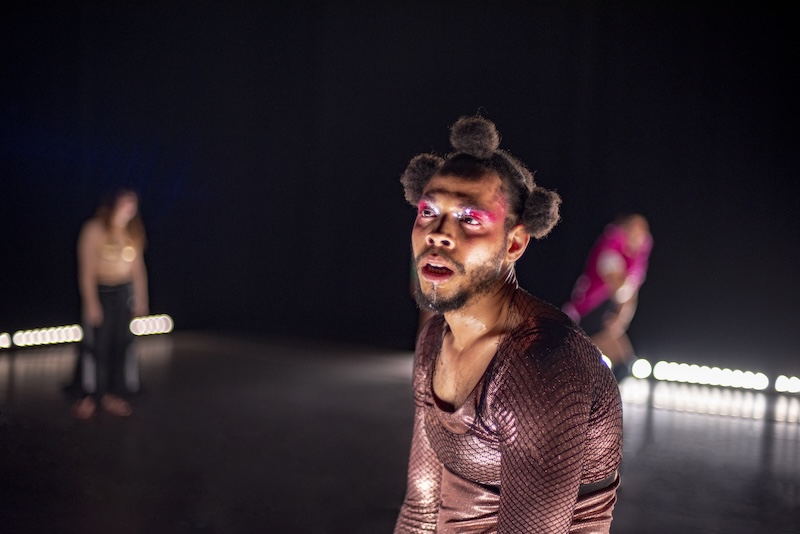
So of course, I do not resolve anything with the piece, not in the least, but I ask the questions that we asked ourselves throughout the process — and how to transform diversity and commonality into a scenic device. What we found was that the device had to be a construction of shared physical material, of gestures, steps, dances, turns, jumps, facial expressions… where each performer constructs four one-minute phrases with a specific catalogue, such as a jump, ten turns, dances you have danced. As if each one had generated an avatar of themselves, and within that avatar is their culture. An avatar, a cliché of oneself — things that supposedly represent you, some very personal, others more cultural and literally clichés — and we rotate, and in this rotation we inhabit each other’s material. And the training and exercise of the piece informed us about the differences, the agreements, the common ground, and how to inhabit the other’s material — in which you also appear. You are more yourself when inhabiting the other’s material, and yet you can see very clearly that this step does not belong to that person — yet they are shining so much in it. The duality between what is common and what is diverse truly exploded for us.
And I believe the audience must pay attention to see what is happening — to, literally, see. They must be with us, exercising their gaze, almost as an invitation to describe what is happening, because afterwards the device itself makes variations. So it does not stay the same; it is not simply a circuit that exhausts itself in the circuit. What seemed to be something one person was doing, now six people are doing, you know — we kept turning.
There is something burlesque, buffoonish about it; it has a pulse with the audience — us, the ones dancing and being these strange people, everything is slightly strange, slightly comic, slightly exaggerated, histrionic. And of course my invitation is that over the course of the repetitions, the audience stops seeing these people who are strange from the outside. Perhaps if they spend time with us looking at us carefully, perhaps we could think of this as a portrait of the world. That it could belong to all of us — that would be my greatest wish, but it doesn’t necessarily happen. And I also find that part of the invitation to the audience, to whatever emerges within themselves very interesting. I suppose that there will be people who, within that strangeness, begin to find recognisable things — that deep down carnival has something of that, how you put on a costume and how it protects you. You are not yourself, but you are more yourself.
These are things that are buried, but because the frame of the costume is there, you can live them, you can include the whole spectrum of yourself. Something that stimulates me greatly about dance is that it is always unfolding the multiplicity of the spectrum — it is not a matter of choosing, but it is this, and also that. Sometimes it is alternation, but at other times, within the same image everything is present, and you do not necessarily have to delimit it, but allow yourself to live it and cross through it.
– An important part of the research that nourishes your artistic practice is connected to Afro-descendant diasporas in the world, from your culture of origin — Brazil — to the relationship with Spain, where you have lived for years, and also with England, in relation to your encounter with Yinka Esi Graves in your joint proposal A Place to Dance. Could you share a little more about these cultures that have been interweaving across your path, and which in some way you feel have been present within you through your past?
Here we enter delicate territory, and it is evident that I am a white woman, I am read as white, I do not suffer any form of racism. When I speak and my accent is noticeable I may experience some situation, but I do not experience them often, because it is also mixed with the question of class. There is an aura of class — that is why so many people want to be artists, I always think — it is a status; it is one of the few professions where, being poor, you can access certain symbolic benefits. I think class is mentioned very little in the arts, and we should speak more about it, because many of the discourses that are built are very often closely tied to social class. I am a white Brazilian woman who migrates. I have been migrating in Spain for sixteen years, and I do not think there is a Brazilian person who, even being white, can deny the importance and relevance of the African diaspora in the formation of Brazilian culture. And obviously, that is what has been done most, and what is most done — there are people who claim to be complete heirs of colonists, “I am Italian,” they say — because there is also the pathology of people who grew up in a territory that was colonised, where all that is good was white, was European; it is a desire to resemble the centre of discourse, because that is what holds social value.
And this operates greatly, and there is a denial of the civilisational values of African cultures in the formation of Brazil. Everything one knows as the institutional image of Brazil — when you think of Brazil there is carnival, sensuality and joy… — these are elements of African cultures and indigenous peoples, obviously with their mixes, but they are taken as a representation of the national territory without ever attributing, without giving credit and without knowing the history of Afro-descendant and indigenous peoples. It took me a long time to understand this, because in Brazil the history of Portugal and Europe is told, we learn this at school, but you never understand why you eat what you eat, why you dress like you dress, why you dance like you dance, why the Portuguese we speak is open — it is not like the Portuguese spoken in Portugal. This history is not told to you, but we are all submerged in it.
For twenty years a quota policy has been in place in public universities — which Lula introduced in the early 2000s for black and racialised people — and thus began a movement in which black people began to ascend socially through education, and began to tell their own story. That is why I am a great fan of quotas in everything. There should be more quotas for women; it is very important. And Brazil is telling its story differently, which is very necessary, as it is the largest diaspora outside Africa.
For example, I am a white woman, but my grandfather was a black man, married to a very white woman. My father would straighten his hair and I never understood why; my brother did it too. And this makes me see how a country’s culture is present in communities, present in families, and present in my body. This is the reflection I believe is important to make — how cultures are forces in the body, and they affect you, they affect your gestures, they affect everything. The question of identity has occupied me for years, since 2014 when I won a choreographic competition in Madrid. My question was about how violence is transmitted. Because Brazil is a violent country — I have lived through, we have all lived through a great deal of violence in the family — and it is evident, because a country founded on slavery, on the trafficking of human beings, is a radically violent country. This is transmitted, and there I remained with the Shoah, Charles Lanzmann, the question of the Jews and how violence is transmitted like a chain — that makes it difficult to stop. And the act is to interrupt the violence, because violence transmits itself almost naturally. And in Brazil the question of violence was urgent for me, because so much violence had already arrived in my body. And in Oro Negro, in some way, that brought me closer. It is not that I want to represent anything — it is that my body is pure violence. It was pure violence and battlecry.
That is also why I am interested in people who speak of what they know, because they have lived it, because the knowledge is their body, their flesh. And I believe multiple cultures are something like this — the body intercrossed by multiple cultures. For me, in the expression of a person, all culture is already present, as is the collective history that traverses them.
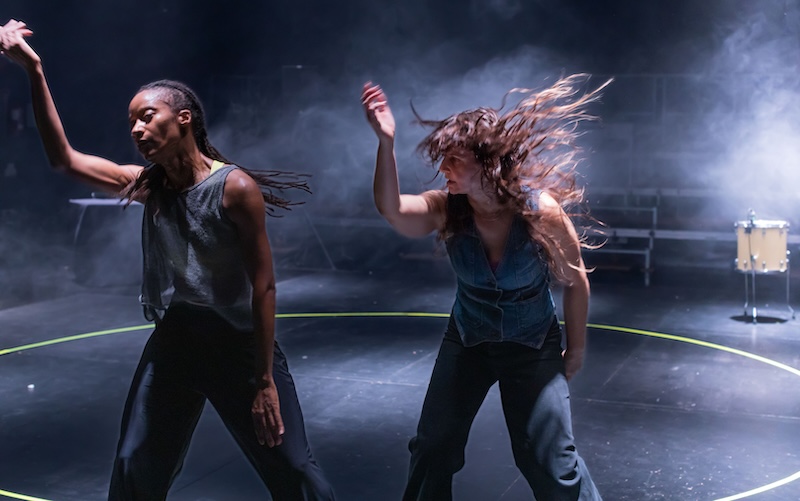
In the project A Place to Dance we began speaking of this, but also of how our body is crossed by multiple places. She is an Afro-British woman, with a Jamaican father and a mother from Ghana, who grew up in England and is also interested in flamenco, living in Seville. And how, in this multiplicity, none of the categories determine or exhaust us. And the conviction that there is no one thing that is more true than another. That is to say, if you have grown up in a very stable culture or have not had the need to question the status quo, things appear to you as truth. And if you have been submerged — through your life circumstances — in the fact that things are done one way in one place, but there are also other ways of doing, then you ask questions. So I cannot impose one over the other; I also believe that an ethical horizon gradually appears, and we have spoken a lot about thiswith Yinka . I also feel that we have coincided on the body as a locus, a very important locus of knowledge and wisdom, and rhythm as a place of union and collectivity. For us it was not that rhythm was just anything — it is an ancestral technology that African diasporas have known how to defend as knowledge, as religion, as science and spirituality, science and art at once; and we in some way invoke this. And what makes sense in an act of dance is to return to the awareness that scenic acts are acts of participation — that the audience has a responsibility, they are there present with us and must bring something of themselves. It is to return to the awareness that, friends, it may seem we are isolated — but no, we are totally intertwined.
– Very directly: what three images are conjured up for you when you think of each of the three pieces you are presenting at Mercat de les Flors — Oro Negro, The Common Ground and A Place to Dance?
For Oro Negro I would say fury. For Common Ground I would say — in Portuguese it is deboche, ut I don’t know what it would be like. For Common Ground I would say mockery, mockery and… yes, joy too, like I felt very free making this — I think it generated an atmosphere of great freedom — but I would say mockery. And for A Place to Dance I would say centre, we shall see what is interpreted by centre, but I would say centre.
– In Oro Negro, a relationship emerges between the different elements: oil and blackness, gold and value, the shining in dialogue with the opaque, clarity and darkness, extractivism and displacement, the individual and the plural, a solo for two bodies. How do these elements dialogue on stage, how do they relate to one another and what do they reveal of all the research you have developed on this proposal?
Well, I knew I wanted to speak about this inheritance, with all the risks that entails — as a creator, as a woman, but a white one, speaking about a theme that perhaps I can only speak of as a foreigner, being outside my own country. I knew I could not touch on the theme of what it means to belong to Brazil, what my Brazilian origin is — which is undeniably also a black origin. I could not speak of this without a black person beside me. So, knowing that I was also placing myself in the eye of the storm of debate, I knew I had the need to do it and I knew from what position I was doing so. A place of honouring, for me — something I feel as a treasure. If I have any joy in belonging to Brazil, it is because of the things I have gradually discovered along the way.
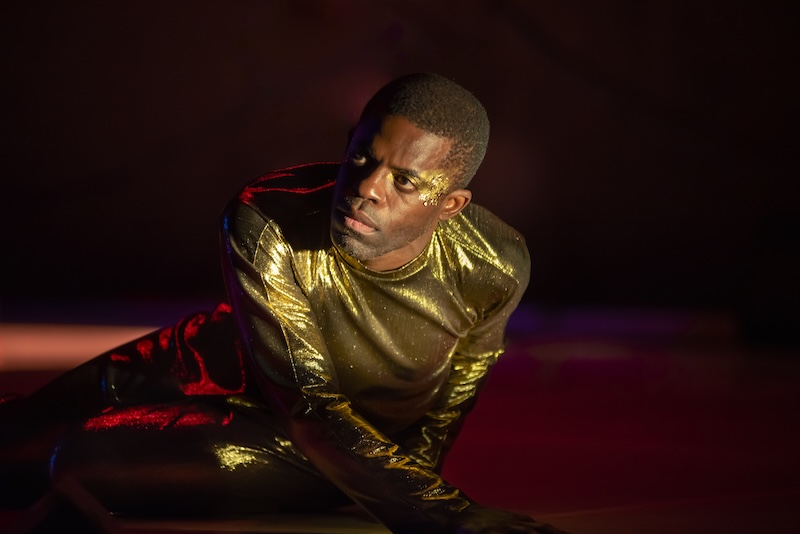
My initial desire was a magical desire — like changing my body for the body of a black man. I was dancing in the middle of the piece and suddenly at some point he appeared, and it is as though I had become this grandfather, because the piece begins with a dedication to my father and to my father’s father. This is what generates the most friction in the piece — this masculine lineage, the power of the masculine, and also that chain of violence. In my case, since violent situations have arrived in my body in a specific way — primarily through a lineage that is masculine, which also happens to be a lineage tied directly to slavery, because I do not know all my ancestors, there are surely more entanglements I am unaware of. So I chose a student who, at the time of Oro Negro, had been my student for eight years, and I proposed that he be the one to accompany me in the piece. I quickly understood that I could not do what was my initial desire — to somehow exchange my body for his — because I thought: as in theatre nobody believes in magic anymore, it simply would not be understood.
The gesture I would like to make, and cannot manage, was for him to be an almost ghostly presence, a silent, constant presence. So that the vanishing point — the point of perspective in the piece — when you escape from me, you find yourself looking through his eyes.
He appears and is on stage the entire time, and we never touch — there is no interaction between his body and mine. For me, it was literally like desire, like his presence as an invitation — as if he were present on another level. And I wear black glasses that cover my entire eyes. It is as if I have no eyes, and he does; I move, I am agitated, I am slow — and he is permanent, he is there and he watches, and I have no eyes and I move.
In Oro Negro there was always the question of excavating — like someone who excavates within their own body as a territory. And in that question of who I am, what I inherit, how this discomfort and the joys that inhabit my body are truly mine, how they arrive towards me, how they shape my body… because what is evident is that my body is not vacuum-packed flesh.
And at some point the word petroleum appeared — which is a resource, truly a treasure, and at the same time the degree of violence required to yield up that treasure is tremendous. And I believe that has also awakened a great deal of discomfort in people, as well as joys, but also discomfort along the lines of: it is not clear, it is ambiguous.
My body is always being read in accordance with Chumo’s body. This black and golden body is always being read in relation to mine, which is white and dressed in black — in accordance with his black body dressed in gold. For me, it is literally the closest way I found, as though my body had been duplicated, as if two things were occurring simultaneously.
And there comes a moment, at the end of the show, when I extrapolate. I go into the stalls and place my face in front of people’s faces — and then I, as creator and performer, realised that Poliana truly does not exist, because each person is experiencing something entirely personal in relation to my body, because my body is a screen. And of course, it reaffirmed my sense of the public dimension even further — that is to say, if I am happy in my dialogues, in my proposal, it is because Poliana truly disappears. In “Poliana” — even though it emerged from experiences that are personal — by placing it in a public space and organising the material in a particular way, I as a person become completely transparent, because each person is seeing their own prejudices, their joys, their fears, what they consider ought to be correct, what they consider is terrible.
– In Common Ground you engage very specifically with the fictional, the fantastic dimension: diversity and community — in some way the individual in relation to the collective. What is the experience in your artistic practice from the dual role of director and performer, in dialogue with all the diversities that form part of this common ground, from the 5 performers to the complete team that form the piece?
Well, with Common Ground I feel that the staging was difficult, because truly when I am performing I cannot see the complete piece — there is a hole. And also for rehearsals, for poloshing, I feel there is also a formal care for the elements, the temporality, the timing of arrivals, that I could not direct any further — because I am inside. And I am also focused on creation, and I cannot rest in the role of performer either. Then you enter the performance and I forget myself. When we are dancing you have to forget that I directed this; we have a wonderful time, and I feel there is a great deal of affection, and that even as we go in to dance, we have a great time and laugh a lot. Mainly because I am the one who makes mistakes, the first to laugh — like, look, guys, I’m so sorry here, I don’t feel at all that it functions from control. I think it works very well to be direct, to say what you need, the instructions, as clearly as possible — but at the moment of performance, and close to performance, it is about autonomy; and the one who has the savoir-faire is the performer, and whatever we do, one must enter with confidence in what one does.
And I feel that yes, we have achieved this. And I believe that was also something interesting — more than one person said to me, Poliana, how beautiful to see that you are there, literally as one of the group. And it is that I truly felt happy doing this process, because when I am with them, while we dance, there is something magical — it is like living my dream world, like it is becoming flesh. How wonderful to be doing this with these people who understand their own flesh in their own way. And I feel that the piece, in some way, allowed this — it was born more from listening than from imposition.
– In A Place to Dance you speak about returning belonging — what would this belonging be at its origin, how does this past emerge to give meaning to the present? The choreographic language in this piece is nourished by rhythm to generate movement — the rhythm of an ancestral, non-hegemonic technology. Could we speak of percussive rhythms from the heart of Africa?
Yinka and I have talked a great deal about the African diaspora in Brazil, and obviously she is a black, Afro-British woman — that is present in her practice 24/7. But we have shared much reflection regarding culture, regarding the way it moulds and generates a certain sense of belonging.
So we went in search of understandings, of encounter, and of the things that connected us. And this also required both of us to step outside what we each do alone, outside what we know how to do, in order to meet. That is to say, to expand our practice in order to embrace what the other does, to meet and understand each other as a place we could embrace and defend.
Apart from that, we shared the reflection on the values we consider incredible in cultures of African origin: rhythm, body and dance — which are not purely decorative elements.
In approaching dance and rhythm as something that generates community, that can heal, that is knowledge and science. And these are forms of knowledge and ways of relating that are not tied to the rational — they are inherent to the body — and for us it was about placing this at the centre. And furthermore rhythm has something collective about it, which expands us beyond the bubble of the modern individual — which literally has a history that begins after 1492. The modern history of the world is tied to the modern history of Europe, in which the body is separated from the cosmos. The body appears in a certain way as the self — and now we are at the limit of this.
And with the disastrous consequences this path brings. And it is not disastrous in itself — it is because, clearly, it is being taken to its ultimate consequences and has its limits. So I understand that there is also an intention and a search to reclaim and look towards other cultural forms that have safeguarded technologies and ways of relating with the world. And which are pertinent and which perhaps we should look at, because it matters.
I feel we have already found each other there, in a question that is at once philosophical and political. And we have articulated from rhythm, from the basics. Where is the first rhythm? Well, obviously in breathing. Breathing, the voice and percussive rhythm. What do I know about percussive rhythm? Nothing whatsoever — but I also know that any person can percuss something, so it is also about entering a dance from the minimum.
We also wanted this to be accessible — it does not have to be complex; it can be simple and can be fully affirmed in the body. So we began in that direction. And also because, from a specific culture and an element that seems pertinent and relevant to us, being able to see that this can help all of us. But for that, it is necessary to recognise that no one culture stands above another. We do not address this in the piece in a direct way, but we do, for example, with the invitation extended to DJ Umu Kala, who is from Mauritania though she came to Spain as a very young child. She makes a sonic journey at the beginning and end, passing through various places. These musics pass through various locations on the African continent, but also through various places of the African diaspora. So the audience enters a space that initially may not be the musics they have heard, but they are being invited through another cultural writing to inhabit an element that can also bring us into common ground. That connection. From the ancestral, the cultural, the body.
______
APROPOS are contents created specifically about something happening in our artistic context. On this occasion, in collaboration with Mercat de les Flors, we present this interview on the occasion of the expanded programme presented by Poliana Lima this March.
Photographs: Álvaro Gómez Pidal, Miguel Ángel Rosales

