
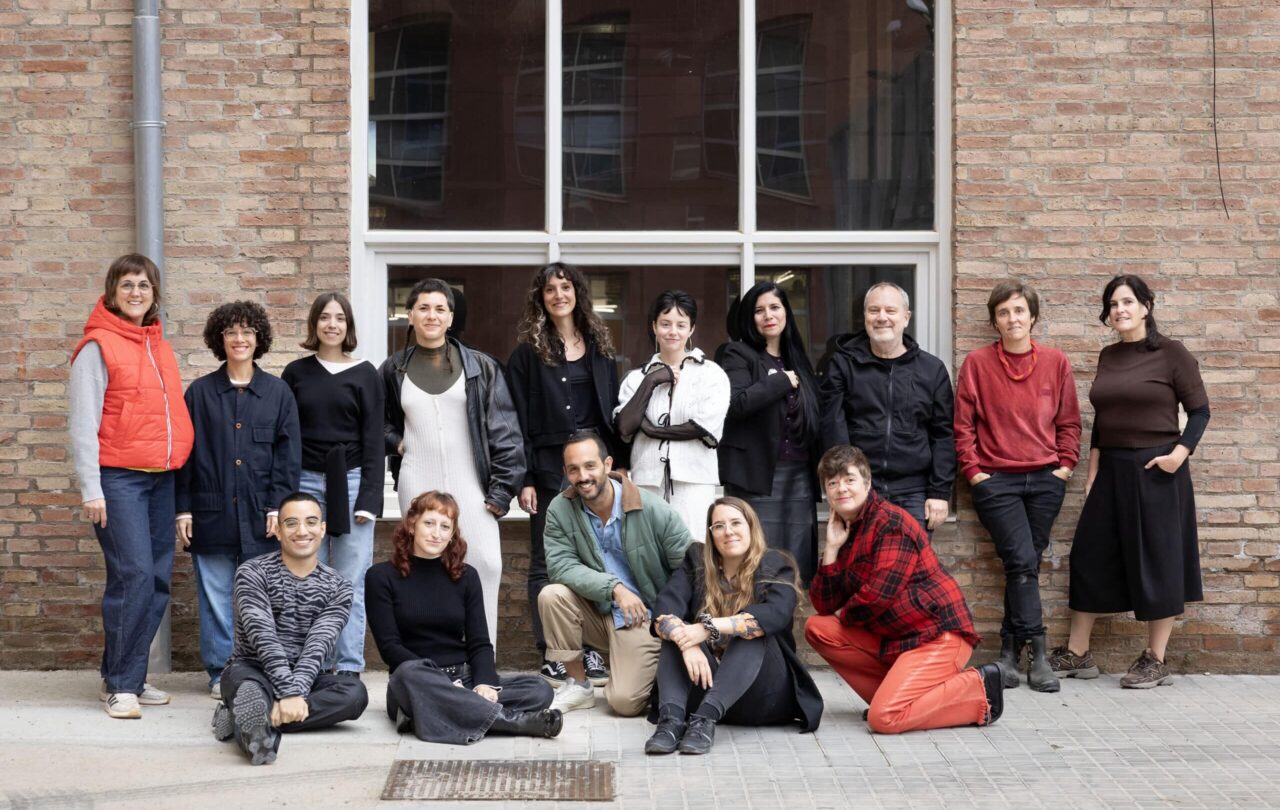
Fabra i Coats: Fàbrica de Creació celebrates the third edition of Pa i fotocòpies on 26 November, an event showcasing the work developed by visual arts resident artists during their residency, with curatorial support from Caterina Almirall and Pilar Cruz.
Pa i fotocòpies is an informal and festive gathering where some of the resident artists will talk about their work and creative processes in a hybrid presentation format hosted by Arturo Aguilar, accompanied by an afternoon snack of bread and chocolate. Pa i fotocòpies is also an opportunity for the artistic community to come together and exchange ideas, as part of the various initiatives promoted by Fabra i Coats: Fàbrica de Creació to support and raise the visibility of its resident artists.
GRAF, in collaboration with Fabra i Coats: Fàbrica de Creació, have invited curator and researcher Antonella Medicito write about the work that the resident artists will present during this session.
Imagining Other Worlds from the Here and Now, by Antonella Medici
Imagining other ways of being in the world does not necessarily mean projecting ourselves towards a distant or radically different reality. Sometimes imagination begins with a minimal shift: paying attention to what usually goes unnoticed, altering a perception, listening to what remains at the margins, or rehearsing other ways of relating to the objects, bodies and environments that surround us. “Can you imagine if another life were possible?” the band Biznaga asks in their song Imaginación política.
The works presented in this edition of Pa i Fotocòpies stem from diverse languages and approaches, but they share a will to question our ways of inhabiting the world and a determination to open up possibilities for existence wherever ways of life seem already predefined or exhausted. Pa i Fotocòpies is a gathering to share artistic research processes, a space to find affinities and experiment shifts: of perception and listening – from the individual to their networks of interdependence – of memory and its capacity for transformation, of the political within all poetics.
Warp and Weft: Memories, Care and Possible Forms of the Common
In the former Fabra i Coats textile factory, weaving evokes both the industrial memory of the site and the gestures, knowledge and forms of labour that historically formed its activity. Out of this relationship with the past, weaving, spinning, sewing and embroidering become practices for recovering and transmitting knowledge, inscribing memories and questioning inherited patterns. Across this journey, which spans from domestic archives to funeral rituals, processes of mourning and bodily experiences, textiles become a practice of care, resistance and shared construction.
In El gest menor (The Smallest Gesture), Mireia García explores the ways memory is passed on through domestic archives and textile techniques such as bobbin lace and cross-stitch. The artist recovers original motifs and transfers them, in layers, onto different supports such as fabric, paper, wax and even light. The repetition of the gesture introduces variations, deviations and errors that turn each stitch into a procedure of re-inscription and reinterpretation. In this way, the work revisits and questions our inheritances, reminding us that memory is not about keeping what we receive intact, but about transforming it.
This transmission of knowledge takes on another dimension in the work by Maria Viñolo Colectivo (amor)tajar, Mortajas: prácticas textiles y tejidas para un nuevo ritual funerario, (Shrouds: textile and woven practices for a new funeral ritual) in which weaving becomes a collective apparatus of care and accompaniment. The project is built around a wooden loom designed so that several people can weave at the same time, which they have worked on for a year, to form an eight-metre-long woollen shroud. Like the Sardinian tapinu ‘e mortu, the piece is intended to absorb the fluids and the traces of the body and soul after death. It is a ritual textile for keeping vigil in community, created from the experiences of women and sexual dissidents, which reclaims other ways of accompanying the dying. Because the ways in which we die also speak of how we live, this collective mesh that holds everything together raises the possibility of reclaiming our sovereignty over them.
The bond between textile, body and memory takes on a more intimate connotation in Quant de lluny pot estar la poma de l’arbre? (How far away can the apple be from the tree?), by Judit Luna. The artist uses embroidery to reflect on her family history and to explore the relationship between illness and institutional control. After undergoing genetic testing to determine whether she had inherited the cancer gene that caused her mother’s death, she transcribes the medical result onto a hand-embroidered bedsheet. The slowness and repetition of the gesture transform the clinical document into a large-format textile piece. Embroidery becomes a space in which to work through the experience of grief, and a form of care and resistance against the systems that quantify and classify our bodies.


Identity Is Not Built, It Is Transcended
Judith Butler explains that identity is not a fixed essence, but is shaped through our experiences, relationships and living conditions¹. From this perspective, the body is not a stable reality but a territory in transformation, a web of relations in which the biological, the technological, the symbolic and the spiritual converge. In the words of Federico Moura, singer of the legendary Argentine band Virus, “identity is not built, it is transcended”. Some of the following artistic practices explore the mutable condition of the body and experiment other ways of inhabiting, protecting and transforming it.
This possibility of imagining other corporealities runs through Este cuerpo que no es mío (This Body is not Mine), by María Pérez Ranchal, a chaptered essay that combines performance and 3D printing to explore the tension between what we are and what we wish to be. In the second chapter, Crisálida (Chrysalis), the artist fabricates a physical avatar to inhabit: a protective carapace printed in semi-transparent resin that combines references to the Christian guardian angel and to the imagery of the anime Evangelion. Printing errors and glitch are incorporated into this kind of exoskeleton, which allows her to try out other forms of existence yet to come.
But transforming the body also means confronting the structures that classify, discipline and determine it. In El error fue atacar (The Mistake was to Attack), Pilar Talavera begins from an auto-ethnographic investigation that connects her experience of Hashimoto’s autoimmune disease with her work as a social media content moderator. Through a sound and performative archive, she gathers sounds and testimonies that make up a soundtrack about the automation of labour, the silencing of pain within the healthcare system, and its effects on the body and psyche. The piece also touches on alternative healing practices linked to faith and belief, as well as regenerative processes in the animal world. The hybrid figure of Medusa frames a reflection on stigma and violence: the one who has suffered harm ends up becoming a monster, while the one who inflicts it remains invested with divine authority.
Continuing this reflection on illness and the ways it is rendered invisible, Mar Flo addresses chronic migraine to explore the relationships between body, pain and medicalisation. Cura, curar, curar-se (Heal, Heal, Heal Yourself) brings together automatic drawings made during episodes, sculptures made from the remains of medicine blister packs, and poems transcribed from patient information leaflets. These media transform clinical language into a narrative traversed by error, memory loss and bodily experience, highlighting the pharmaceutical industry’s violence towards women’s bodies. Writing, drawing and material experimentation act as crutches that sustain the creative process and make it possible to rework pain, experimenting other ways of relating to it.


Shifting Perception: Other Forms of Listening, Attention and Intuition
Several of these works use listening, attention and intuition to explore things that escape immediate knowledge and flood rational systems of interpretation. These practices open access to dimensions of experience that are hard to translate, in which sounds of the alien, the intimate or the collective blur the boundaries between what is private and what is shared, and reveal other forms of relationship built between subjects, environments and presences.
In Sessió oberta: cartografies d’un espiritisme digital, (Open Séance: Cartographies of a Digital Spiritism), Laura Torres Bauzà explores the connections between nineteenth- and twentieth-century spiritualism and contemporary forms of interaction with artificial intelligence. Drawing on publications, séance records and conversations, the artist creates an archive that combines spiritualist methodologies with her own dialogues with AI, which she consults about present-day concerns. As Erik Davis points out in TechGnosis², in the context of the Industrial Revolution electricity and the telegraph fuelled occultist imaginaries of communication with the invisible. Following this genealogy, today artificial intelligence can be understood as a new form of mediation with the unknown, that reignites old fantasies of communication beyond the limits of our perception. Yet its errors and anomalies evoke the unease of horror cinema in the finest Cronenberg style: the technology that was supposed to remain under control now seems to be acquiring a life of its own.
From devices that mediate with the invisible to the permeability of bodies and their environments, Porifera, by Isabel Val, proposes a project of sonic speculation that imagines listening as an experience traversed by what exceeds the limits of human understanding. Conceived as a radio piece in three parts – outer world, inner world and other worlds – it combines the capture of radio frequencies beyond the audible spectrum, using self-built devices, with conversations with artists. The reference to poriferan organisms allows us to consider permeability as a condition of existence: the limits of the body are not closed borders, but surfaces of contact and exchange with the environment. In this way, the piece breaks with the idea of an autonomous, self-enclosed subject, and suggests that being in the world necessarily means allowing oneself to be affected by it.
This attention to what traverses us takes on a more intimate dimension in the third part of Postales sonoras de la intimidad (Sound Postcards from Intimacy), by Valo Sonoro. In this work of “chronic listening”, a group of people gather to share healing tools and practices linked to illness and permanent pain, which are then edited into a playable cassette. The project stems from Valo’s experience as a type 1 diabetes patient and considers how sustained attention to bodily pain can reveal what communication leaves hidden, as well as open new paths of access to forms of knowledge that had remained buried.
Listening also shifts towards the unexpected relationships that arise in shared spaces. In Dissonant-ascendent, Maria Pipla uses sound and visual recordings to investigate the life of a community of musicians in a building of rehearsal rooms in La Verneda district. Her explorations through the common areas and their off-screen spaces allow her to reconstruct a collective soundscape in which spatial proximity and isolation paradoxically coexist. The research takes the form of an expanded publication made of hand-cranked music boxes whose punched strips translate images and sounds. When played collectively, these devices generate a dissonant, polyrhythmic audiovisual composition that makes the web of relationships that sustains every community heard.
In turn, Berta Asensio Casasús takes listening into the realm of grief in L’eco del silenci, Arqueologia sonora i pràctiques d’arxiu al voltant de la tradició campanera, (The Echo of Silence. Sound Archaeology and Archival Practices around the Tradition of Campanology), a project that recovers the ritual and communal meaning of manual bell-ringing. The breaking of a set of ceramic bells, conceived as fragile sound objects, shifts the research towards absence and the persistence of sound through its recording. The artist presents a sound composition made from the recordings of those bells, accompanied by a score derived from an electrocardiogram on her father. The trace of a heartbeat that is no longer here converses with the sound of bells that have fallen silent, in an action that turns listening and memory into ways of accompanying loss.


Other Worlds That Are Our Own
How can we imagine other ways of inhabiting a planet shaped by extractivism and technological transformation? The works gathered in this section approach this question through science fiction, biological speculation and the exploration of landscape. Through imagined worlds, barely perceptible ecosystems and territories that escape the logics of exploitation, the works shift our gaze towards other forms of life and interdependence. Rather than projecting distant worlds, the aim is to recognise the unknown and the invisible that already dwell in our own.
In Cerion 9X: cartografías de una biosfera deshabitada, (Cerion 9X: cartographies from an uninhabited biosphere) Daniel Cao sets out from the imaginaries of science fiction and their appropriation by techno-capitalism, from terraforming to the colonisation of other planets. Using photographs of liminal spaces and brutalist architecture, he constructs a space opera film in found footage format, in which a space adventurer explores an unknown planet. That territory, however, turns out to be our own Earth; the journey into the unknown thus becomes a reflection on melancholy and on the (im)possibilities of inhabiting our own world.
Mercè Rodoreda’s poetic text La flor dolenta (Bad Flower) inspires Tatiana Donoso in her work Primavera sintética. Flors i poemas per a l’amnèsia tèxtil (Synthetic Spring. Flowers and Poems for Textile Amnesia). Like Rodoreda’s “mussel-flower”, her cross-stitched flowers do not correspond to a botanical reality but to a biological fiction that highlights the lack of visual representations for the chemical processes and material transformations that make today’s synthetic fabrics possible. As in Rodoreda’s text, the flowers imagined for Lycra, nylon and polyester acquire human, fantastical and even monstrous features. Embroidery functions here as a form of writing and of reading, able to approach what traditional textile imaginaries fail to name.
This exploration of other worlds moves towards real, if barely perceptible, ecosystems in Apnees i altres gramàtiques (Apnoeas and Other Grammar), by Anna Pascó Boltà. At the intersection of art and science, the artist investigates ecosystems that, because of their scale or location, escape our direct perception, such as microbial worlds and the seabed. Through sculpture, photography, archives and perfumes, she composes speculative maps of these submerged worlds, populated by creatures and mythological figures. In the face of technological mediation and information systems, the artist turns to radical imagination to draw up other cartographies of the unknown and rethink our relationship with the environment. Ultimately, it is about imagining what we do not see, yet which sustains our existence.
The possibility of recognising other forms of life at the margins of the landscape also runs through Traspassar la terra, (To Pierce the Earth), by Cristina Calderón. The artist begins from Gilles Clément’s notion of the Third Landscape – residual spaces, outside planning and exploitation – to imagine territories that escape extractive logics. Using photogrammetry and 3D scanning, she transforms small landscape models into human-scale three-dimensional projections, through which she articulates a somatic, ecofeminist narrative in four movements. The fascia (the web of tissue that connects and supports the organs) serves as a metaphor for the interdependence between bodies and ecosystems. The models become bodies and territories, while holographic error and digital phantasmagoria open up other forms of perception. In dialogue with the thought of Donna Haraway, the work proposes an affective and situated relationship with the landscape, understood to be the only possible way of knowing our surroundings³.


There Is No Politics Without Poetics
Through personal archives, situated wisdom and everyday gestures, some of these practices question dominant narratives and attend to experiences and ways of life that remain at their margins. The poetic is here a political form of intervention in the sensible, capable of opening up other spaces of relationship, intimacy and resistance.
In Rotativa que mai no s’atura, (Rotary Press That Never Stops ), Chuso Ordi returns to his past to speak of the enduring relevance of the forms of discipline and the mechanisms of stigmatisation that marked a generation: the stigmatisation of HIV/AIDS and antimilitarism. To do so, he recovers one of his own illustrations, published in 1993 in Diari de Nou Barris – a composition of eight identical heads in positive and one in negative at the centre, which refers to the slogan “silence=death” – as well as a photograph taken in 1989 of graffiti about refusal of compulsory military service. Ordi works with repetition and doubling through drawing and video to reflect on our relationship with otherness: any body could occupy any of those figures. In conversation with Susan Sontag and her critique of military language applied to illness, the work also introduces a paradox that echoes Rimbaud’s assertion: “Je est un autre”.
Attention to what dominant narratives leave at the margins finds another expression in the work of Gemma París Romia. In Rebel rebel, the artist uses painting, drawing and textile to make visible the forms of life that remain at the margins. She turns to botany to get to know the kind of beauty we never quite manage to see: she explores residual spaces and the wild species of the undergrowth, persists with drawing and attends to small gestures. This research connects with her earlier work Enlloc millor que aquí (Nowhere Better Than Here), in which, together with older women from Lleida, she made textile banners to recover knowledge from the farming tradition relating to the uses of plants such as the dandelion. These encounters fostered spaces of trust and intergenerational transmission, in which the rebel species also found a new space of freedom.
From attention to what remains invisible to the need to pause and look differently, Conversaciones con el muro rojo (Conversations with the Red Wall), by Carmen de Ayora, questions the ways images are produced in a world saturated with them. Through found objects, poetry and performative actions, the artist explores how we construct and inhabit our own ideas. A black armchair bearing the inscription “stay still”, or a canvas sheet that invites us to “keep the faith”, introduce a reflection on stillness as an alternative to the imperatives of productivity and visibility. Against these, she proposes shifting ways of making art towards intimacy and care: “Don’t be afraid”. Tenderness here is not a minor gesture but a political force for sustaining life – perhaps our only chance of salvation.


In the face of the crisis running through our present, these practices experiment other horizons of possibility based on what sustains and traverses life: everyday gestures and transmitted knowledge, memories and their re-readings, vulnerable and dissident bodies, relationships of interdependence between ecosystems. By shifting attention towards what usually remains off-screen, these works question the dominant ways of perceiving, producing knowledge and relating to our surroundings, in a more poetic and, therefore, more political way. Against the logics of efficiency, productivity and standardisation, waiting, listening and error open up spaces in which to imagine other forms of freedom, resistance and life in common. This is an invitation to keep weaving these relationships, to knead together and let ideas ferment at a different pace. The works by the artists presented in this edition of Pa i fotocòpies reclaim imagination as a collective practice, capable of widening the horizons of the possible and opening new paths for thinking and experimenting other forms of existence.
__________
¹ Judith Butler, Gender Trouble. Feminism and the Subversion of Identity. New York: Routledge, 2006
² David, Erik, Techgnosis. Myth, Magic an Mysticism in the Age of Information. New York: Harmony Books, 1998
³ Haraway, Donna, Staying with the Trouble: Making Kin in the Chthulucene. Durham and London: Duke University Press, 2016
⁴ Susan Sontag, Illness as a Metaphor. Aids and its Metaphors. New York: Farrar, Straus and Giroux, 1978
Photographs by Pere Virgili
